Expansion
Penn State expands Flock to Behrend
WJET/WFXP reports three Flock cameras around the Erie campus: two on Jordan Road and one on Knowledge Parkway.
What Penn State told WJET/WFXP
“access to the camera footage is restricted to trained and authorized university police and public safety personnel”
“campus safety is their top priority”
What that leaves out
Penn State first described the deployment as a limited pilot. This report says the university is installing cameras on the perimeter of multiple campuses. Behrend is now a documented expansion, not a single-campus test.
The access statement describes which Penn State employees may use the system. It does not disclose the thousands of outside camera networks those employees can search, or the reciprocal network access that can expose Penn State camera data to participating agencies. The public remains locked out of records about both.
Inside the Eisenhower camera view
The interface ties plate reads to Penn State locations
These interface captures show Eisenhower-named entrances, exits, and the parking deck alongside license-plate camera views and aggregate activity figures. Plate numbers, timestamps, workstation and device identifiers, and other record-level details have been obscured for publication.
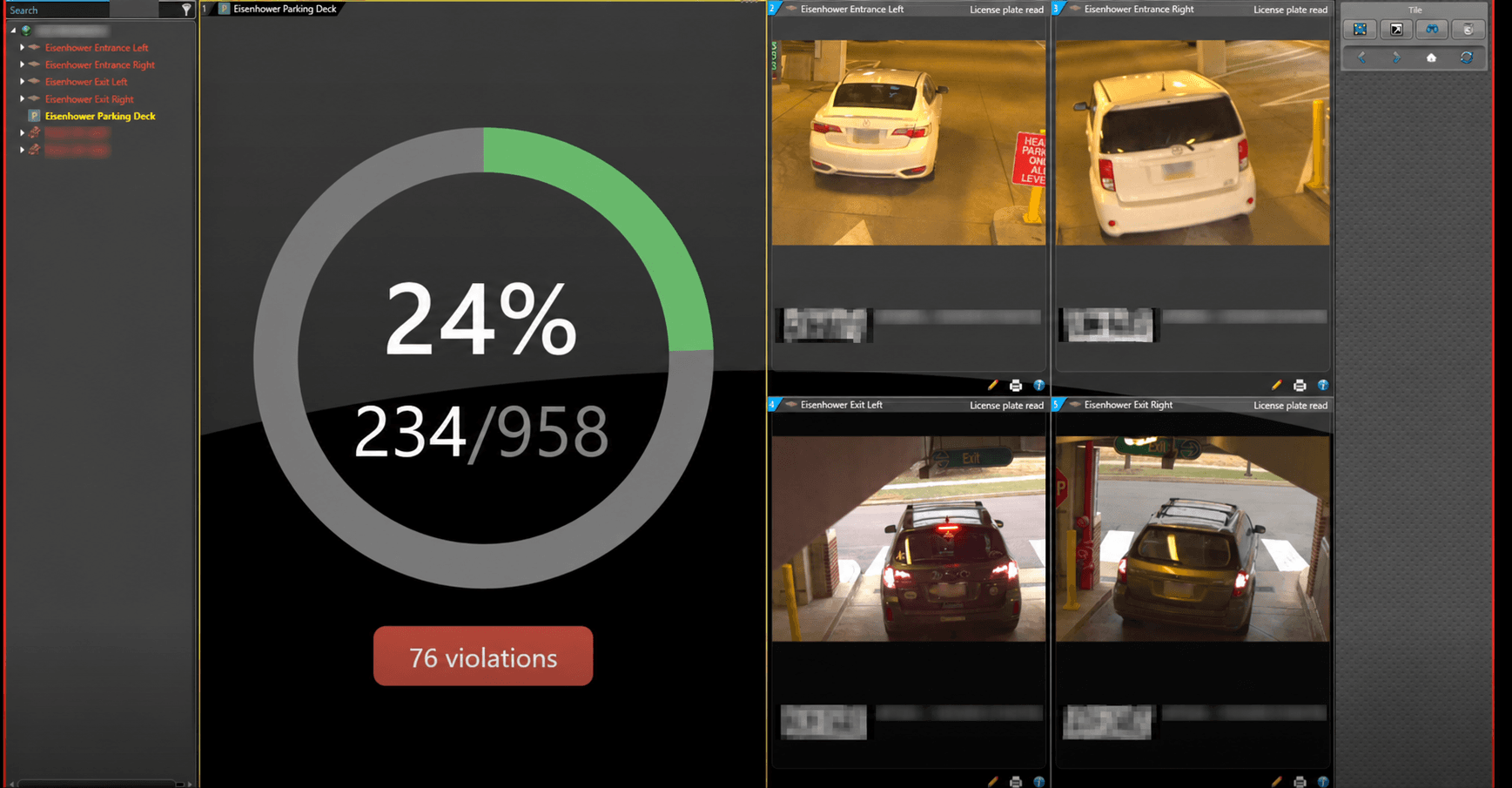
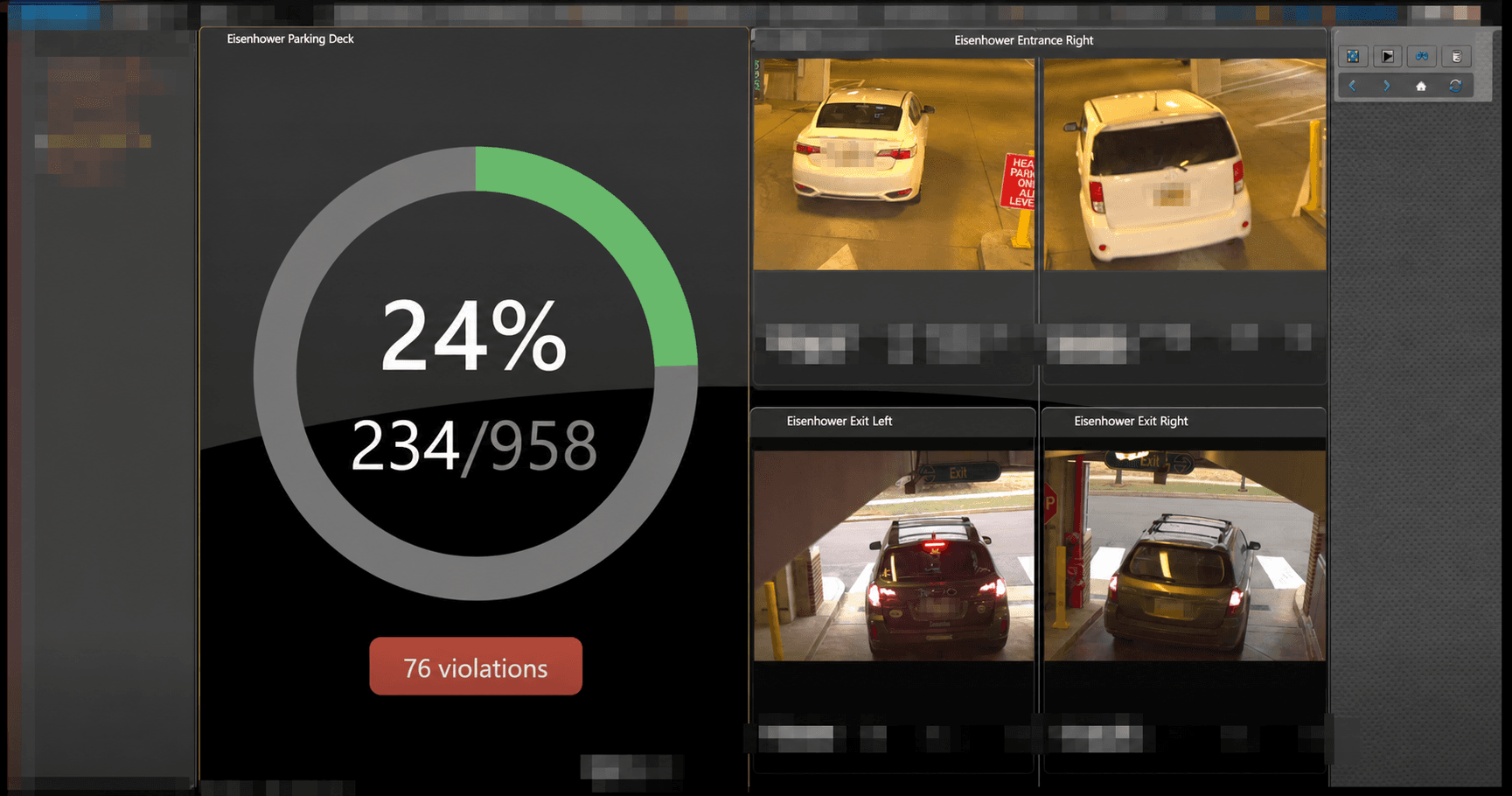

Source: 2Interface captures supplied by the site author · privacy-redacted for publication
Penn State's own roadmap
UPPS calls AI video analysis “Proactive Surveillance”
In a Penn State University Police and Public Safety presentation titled The next 100 years..., Physical Security describes cameras that detect, classify, and analyze behavior in real time. ALPR is one line item in a much longer wish list. Slide by slide, the deck lays out where UPPS says campus security is heading:
- “AI Powered Video Analytics aka (Proactive Surveillance)”
- Cameras that “detect, classify, and analyze behavior (e.g., loitering, unusual movement, crowds) in real-time.” The parenthetical is UPPS's own label, not ours.
- “Advanced Biometric Access Control”
- Fingerprint, facial recognition, and palm vein scanners described as “becoming standard,” with “integration with AI for anomaly detection.”
- “Autonomous Robots & Drones”
- Robotics and drones for automated perimeter patrol, “acting as mobile surveillance nodes.” A later robotics slide itemizes aerial drones (“drone as first responder”), EOD, tactical, patrol — and humanoid.
- “Artificial Intelligence”
- Three bullets: crime analysis, video analysis, and social media analysis. The deck does not say whose social media, or under what policy.
- “Smart Vehicles” and “Wearables”
- Police vehicles with networked location and telemetry, integrated cameras, and GPS launchers that tag fleeing cars with trackers; officers with body-worn cameras and “health and wellness tracking.”
- “Real Time Crime Centers”
- The convergence slide. Data sources listed: CCTV, body-worn cameras, ALPR, shot detection, alarm systems, geolocation data, and access-control systems.
The Information Technology section opens with a full-slide image of RoboCop — presented without irony. The deck closes by saying these technologies are aimed at reducing “alert fatigue,” faster incident response, and “overall operational efficiency.” Privacy appears once, in a slide about sensors that avoid capturing images. Read the whole thing:
Open the 28-slide Penn State UPPS presentation (PDF, 3.7 MB)Source: 3Penn State Finance and Business · University Police and Public Safety